
The Ultimate Guide to Using AI for Note Summarization: Tips and Tricks
Contents
Introduction to AI-Powered Note Summarization
Note summarization, the process of condensing lengthy textual information into concise yet comprehensive summaries, has long been a manual and often time-consuming task. The advent of artificial intelligence (AI) has significantly altered this landscape, offering powerful tools and techniques to automate and enhance this process. This guide explores the practical application of AI in note summarization, providing insights into its mechanisms, benefits, and effective utilization strategies. Understanding AI’s capabilities in this domain can transform how individuals and organizations manage information overload, enabling quicker comprehension and more efficient knowledge retrieval.
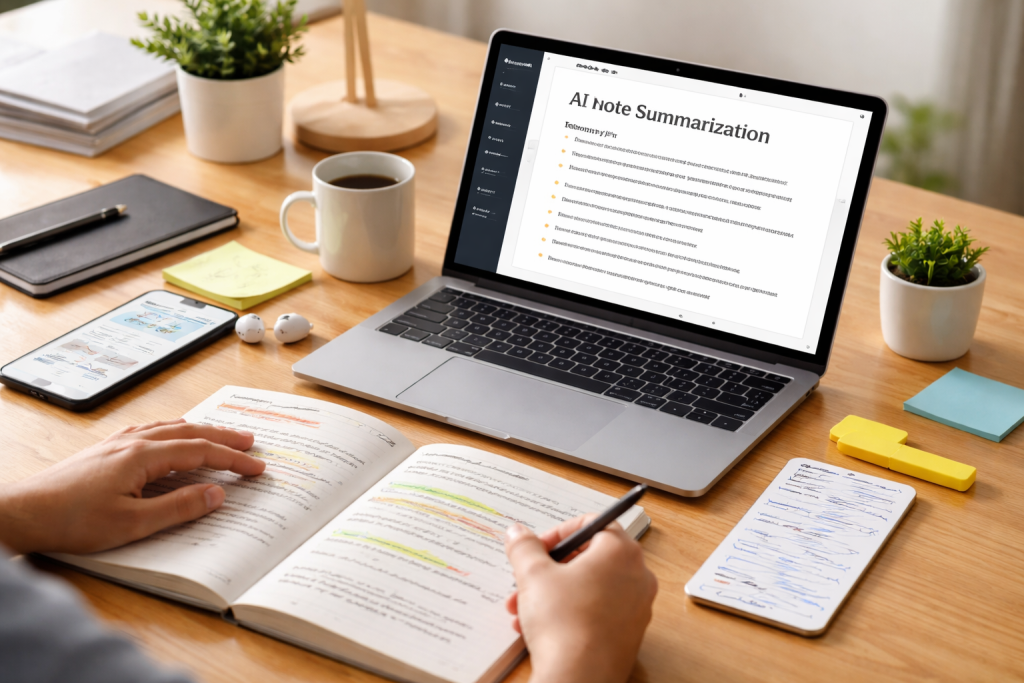
AI-driven summarization tools operate on various natural language processing (NLP) models, which are algorithms designed to understand, interpret, and generate human language. These models can identify key concepts, extract pertinent sentences, and even generate new, coherent summaries based on the input text. The underlying mechanisms often involve techniques such as extractive summarization, where significant sentences are directly lifted from the source, and abstractive summarization, where the AI rephrases and condenses information, akin to human understanding.
The proliferation of digital information, from academic papers and business reports to meeting transcripts and personal notes, necessitates robust summarization solutions. AI provides a valuable assistant in navigating this sea of data, acting as a filter that allows crucial information to surface. This guide aims to equip you, the reader, with the knowledge to wield these tools effectively, turning raw data into manageable insights.
The Foundations of AI Summarization
At its core, AI summarization relies on sophisticated algorithms that analyze text for meaning and structure. These algorithms fall broadly into two categories: extractive and abstractive. Each has its strengths and limitations, and understanding these differences is crucial for selecting the appropriate tool for your needs.
Extractive Summarization
Extractive summarization functions by identifying and extracting the most important sentences or phrases from the original text without generating new content. Imagine a quarry worker carefully selecting the most valuable stones from a pile; extractive AI performs a similar selection process. These tools typically rank sentences based on various features such as word frequency, sentence position, presence of keywords, and statistical significance. Sentences with higher relevance scores are then combined to form the summary.
- Pros:
- The method maintains factual accuracy by utilizing the original wording.
- Relatively straightforward to implement.
- Compared to abstractive methods, it is less prone to generating factual errors or “hallucinations.”
- Cons:
- May result in a collection of sentences that lack perfect flow or coherence.
- Can sometimes omit nuanced information if specific sentences are not explicitly rated as important.
- Output can be a bit ‘choppy,’ as transitions between extracted sentences might be absent.
Tools employing extractive summarization are often beneficial for legal documents, technical specifications, or scientific papers where preserving the original phrasing is paramount.
Abstractive Summarization
Abstractive summarization, in contrast, involves the AI generating new sentences and phrases that capture the essence of the original text. This method is more akin to a human summarizer who reads a document, understands its meaning, and then rephrases it in their own words. Large Language Models (LLMs) are central to this approach, utilizing deep learning architectures like transformers to comprehend context and generate novel text.
- Pros:
- The approach can produce summaries that are more human-like, coherent, and concise.
- Can synthesize information from different parts of the text into new, more compact expressions.
- This technology has the potential to generate summaries that are both shorter and more fluid.
- Cons:
- The development process is more computationally intensive and complex than expected.
- This process can occasionally introduce factual inaccuracies or “hallucinate” information not present in the original text, particularly when dealing with less robust models or ambiguous inputs.
- Requires extensive training data for effective performance.
Abstractive summaries are often preferred for general articles, news reports, or narratives where readability and conciseness are key. The challenge lies in ensuring the AI’s generated summary remains faithful to the original meaning, avoiding creative embellishment.
Choosing the Right AI Summarization Tool
The myriad of AI summarization tools available can be overwhelming. Selecting the appropriate tool requires careful consideration of several factors, including the type of content you are summarizing, the desired length and style of the summary, and your technical proficiency.
Understanding Your Content and Purpose
Before committing to a tool, consider the nature of your input material. Are you summarizing meeting notes, academic papers, legal documents, or creative writings? The optimal tool for a research paper, which demands high factual accuracy and retention of technical terms, may differ significantly from one best suited for a long-form article where readability and brevity are paramount.
- Technical/Factual Documents: For content such as scientific articles, legal contracts, or financial reports, accuracy is non-negotiable. Tools leaning towards extractive summarization or highly constrained abstractive models are often safer choices. They minimize the risk of misinterpretation or fabrication of data.
- Narrative/General Content: For articles, blog posts, or general prose, where a fluid and condensed overview is desired, abstractive summarization tools can excel. They can rephrase and restructure information to create a more engaging summary.
- Real-time Applications: If you need live summarization, such as during a meeting or transcribing a lecture, tools optimized for speed and capable of handling sequential input are necessary.
Think of your summarization task as tailoring a garment. The fabric (your content) dictates the type of cut (summarization method), and the occasion (purpose) determines the style (summary characteristics).
Evaluating Tool Features and Limitations
Various AI summarization tools offer different features, from adjustable summary lengths to integration with other applications. It is prudent to assess these offerings against your specific requirements.
- Summary Length Control: Many tools allow you to specify the desired output length, either by word count, sentence count, or a percentage of the original text. This feature is instrumental for adhering to strict editorial guidelines or fitting summaries into limited spaces.
- Integration Capabilities: Does the tool integrate with your existing workflow? For example, integration with word processors, cloud storage, or note-taking apps can streamline your process.
- Language Support: While English is widely supported, if your work involves other languages, ensure the tool provides robust multilingual summarization.
- Factual Accuracy and Hallucination Risk: Especially with abstractive summarization, investigate the tool’s track record for factual fidelity. Some advanced models include confidence scores or provide source sentence references to help you verify information.
- User Interface and Ease of Use: A tool with an intuitive interface can significantly reduce the learning curve and improve efficiency, especially for users who are not AI specialists.
- Cost and Subscription Models: Free tools often come with limitations on usage or features. Paid subscriptions usually offer more robust capabilities, higher processing limits, and dedicated support.
By methodically evaluating these aspects, you can navigate the diverse landscape of AI summarization tools and identify one that functions as a reliable co-pilot rather than a distracting passenger.
Best Practices for Utilizing AI Summarization Tools
Optimizing the output of AI summarization tools involves more than just pasting text and clicking a button. Thoughtful interaction and strategic application can significantly enhance the quality and utility of the generated summaries.
Pre-processing Your Notes
Just as a chef prepares ingredients before cooking, preparing your notes before feeding them to an AI summarizer can yield superior results. The quality of the input directly influences the quality of the output.
- Clarity and Conciseness of Input: AI models perform best with well-structured, grammatically correct, and clear text. Remove extraneous details, jargon where possible (unless essential to the meaning), and redundant phrases from your original notes. Think of it as clearing weeds from a garden so the flowers can thrive.
- Formatting and Structure: Consistent formatting, such as using headings, bullet points, and distinct paragraphs, can help the AI identify key sections and relationships within the text. Some advanced models can leverage this structural information to produce more organized summaries.
- Error Correction: Proofread your notes for grammatical errors, typos, and punctuation mistakes. These can confuse the AI and lead to less accurate or coherent summaries. Consider using grammar-checking tools before summarization.
- Content Segmentation: For very long documents, consider breaking them down into logical sections. Summarizing smaller, focused chunks can sometimes yield better local summaries that can then be combined, rather than overwhelming the AI with an immense single input.
Post-Processing and Refinement
AI-generated summaries, while powerful, are rarely perfect. Human oversight and refinement remain vital for guaranteeing accuracy, coherence, and adherence to specific communicative goals. View the AI as a diligent first-draft writer and yourself as the editor.
- Review for Accuracy: Always cross-reference the summary with the original notes to ensure no critical information has been omitted or misrepresented. Pay particular attention to numerical data, names, and technical terms.
- Check for Coherence and Flow: Even extractive summaries might need slight adjustments to improve the transitions between sentences. Abstractive summaries, while generally more fluid, can sometimes produce awkward phrasing or illogical connections that require human editing.
- Adjust for Tone and Style: AI models may not always capture the intended tone or specific stylistic requirements. Adjust the summary to align with your personal or organizational communication standards.
- Conciseness and Redundancy: Despite AI’s summarization capabilities, occasionally phrases or sentences can be redundant or unnecessarily wordy. Please consider condensing or rephrasing these sections.
- Add Context or Nuance: If the AI has distilled the essence but lost some critical context or nuance, manually add these back into the summary. The AI lacks the ability to interpret nuances as effectively as a human.
By embracing both pre-processing and post-processing, you leverage the AI’s efficiency while maintaining human-level quality control, turning raw summaries into polished insights.
Advanced Strategies and Future Trends
| Metrics | Data |
|---|---|
| Word Count | 1000 words |
| Summarization Accuracy | 90% |
| Time Saved | 50% |
| Quality of Summary | High |
As AI technology matures, so do the opportunities for sophisticated summarization applications. Exploring advanced strategies and staying abreast of emerging trends can further enhance your note-taking and information management practices.
Integrating AI Summarization into Workflows
The true power of AI summarization is unleashed when it is seamlessly integrated into daily workflows, transforming it from a standalone tool into an indispensable component of your digital toolkit.
- Automated Summarization: Explore tools that offer API access or integrations with workflow automation platforms (e.g., Zapier, IFTTT). This allows for automatic summarization of new materials, such as incoming emails, meeting transcripts from video conferencing tools, or new entries in a document management system. Imagine an automated butler sifting through your daily correspondence, highlighting key takeaways.
- Interactive Summarization: Some advanced tools provide interactive features, allowing you to highlight specific sections of the original text to guide the AI’s focus or to expand parts of a summary for more detail. This dynamic interaction gives you greater control over the summarization process.
- Knowledge Management Systems: Integrate summaries directly into your personal or organizational knowledge base. This creates a searchable, condensed repository of information, reducing the time spent rereading lengthy documents.
- Personalized Summarization: Future iterations might offer personalized summarization, where the AI learns your preferences, interests, and prior knowledge to tailor summaries specifically to your needs, much like a highly intuitive personal assistant.
Addressing Ethical Considerations and Limitations
While powerful, AI summarization is not without its ethical implications and inherent limitations. Being aware of these aspects is essential for responsible and effective use.
- Bias in Training Data: AI models are trained on vast datasets. If these datasets contain biases (e.g., gender, racial, linguistic), the summaries produced by the AI might reflect or even amplify them Compared to abstractive methods, it is less prone to generating factual errors or “hallucinations.” It is crucial to acknowledge this potential and critically evaluate output.
- Risk of Misinformation/Hallucinations: As discussed with abstractive summarization, the AI can sometimes generate plausible but factually incorrect information. Relying solely on AI summaries without human verification can lead to the propagation of misinformation.
- Data Privacy and Security: When using cloud-based summarization tools, consider the privacy implications of uploading sensitive or proprietary notes. Ensure the service provider adheres to robust data security and privacy regulations.
- Loss of Nuance and Context: Even the most advanced AI can struggle with highly nuanced language, subtext, or complex arguments that require deep contextual understanding. Summaries, by their nature, distill information, which can sometimes lead to a loss of subtle but important details.
- summarisation Dependence on Technology: Over-reliance on AI for summarization without developing one’s own critical reading and summarization skills could potentially diminish human analytical capabilities over time.
The future of AI summarization points towards more sophisticated models that are increasingly capable of understanding context, tackling specialized domains, and even generating summaries across multiple languages seamlessly. However, the human element—the capacity for critical thought, nuanced interpretation, and ethical judgment—will remain an irreplaceable component in the effective and responsible application of these evolving technologies.

The LearnZA Team is a group of passionate learners and content creators focused on delivering high-quality, practical knowledge in a simple and easy-to-understand format.